
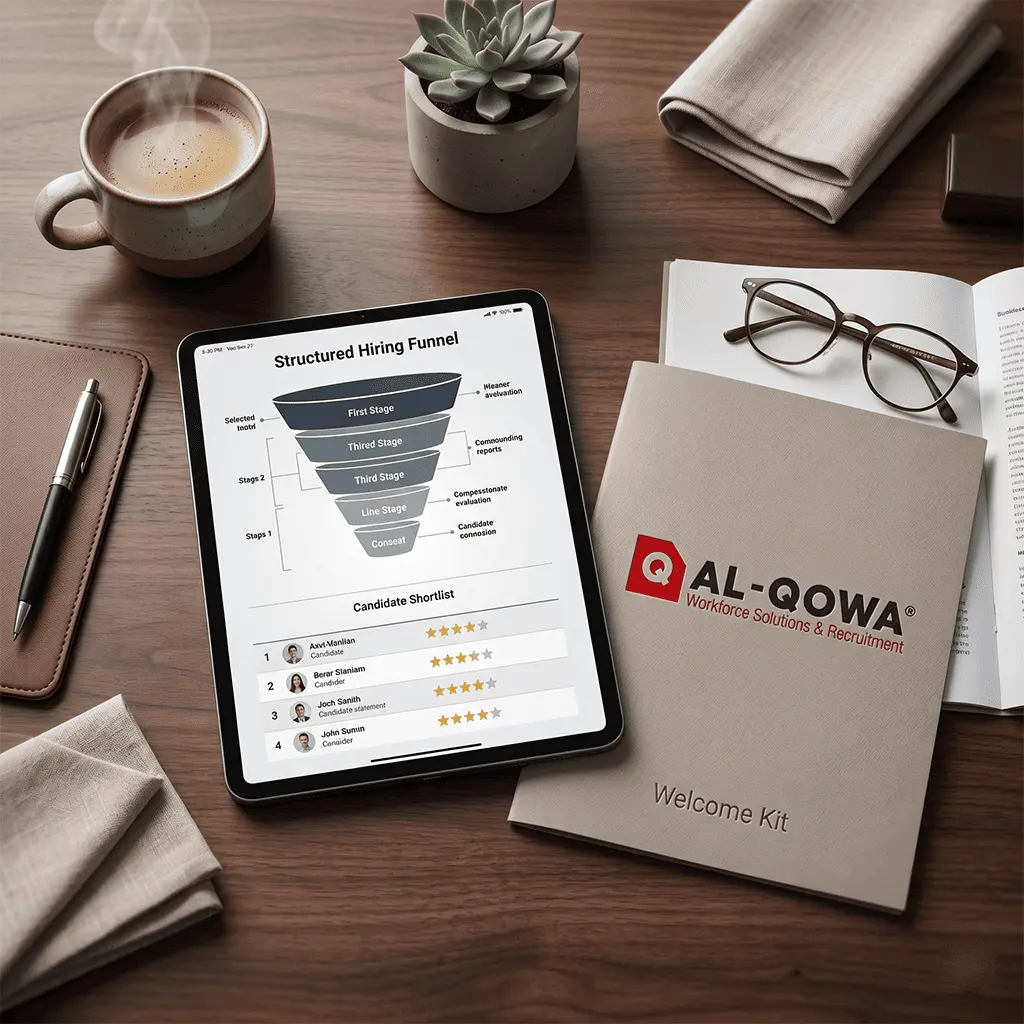
Most hiring problems are not about talent — they are about process
Think back to the last time a hire did not work out. The candidate looked right on paper. The interview went well. Nevertheless, three months in, it was clear something had gone wrong.
Now ask yourself: was the problem really the person — or was it the process that selected them?
In most cases, it is the process. Informal hiring, gut-feel decisions, rushed timelines, and unclear role definitions do not just produce bad outcomes occasionally. They produce them consistently. Moreover, in a market like Libya, where workforce challenges are layered on top of regulatory complexity, the cost of getting hiring wrong is amplified at every stage.
This article lays out exactly what a structured recruitment process looks like, why it matters, and how companies operating in Libya can use it to hire better, faster, and with far less risk.
What a structured recruitment process actually means
A structured recruitment process is a systematic, repeatable approach to hiring — one that follows clearly defined stages from identifying a staffing need all the way through to onboarding and integration.
Where informal hiring relies on instinct, availability, and improvisation, a structured process introduces consistency. Every candidate is evaluated against the same criteria. Every stage has a defined owner and timeline. Every decision is documented.
The core stages typically include a needs assessment and job definition, strategic candidate sourcing, standardized screening and evaluation, structured interviews, selection and contract management, and finally a formal onboarding program. Together, these steps turn hiring from a reactive scramble into a managed process — one that produces better results and is far easier to improve over time.
The real cost of unstructured hiring — and why it adds up fast
Most companies that rely on informal hiring do not fully account for what it costs them. The visible expense — the recruiter fee, the job posting — is only a fraction of the total. The real cost lives elsewhere.
Subjective decisions and the mismatched hire problem
Without a clear evaluation framework, hiring decisions default to personal judgment. And personal judgment, however well-intentioned, is inconsistent. One interviewer values confidence above all else. Another prioritizes experience. A third hires the candidate who reminded them of someone they once worked with.
The result is a pattern of mismatched hires — people who seemed right in the room but do not perform in the role. They leave, or they are let go, and the entire process starts again. High turnover is not just expensive. It is demoralizing, disruptive, and often entirely preventable.
Time and cost: what slow, disorganized hiring really costs a business?
Unstructured hiring does not just produce bad outcomes — it takes longer to produce them. Without defined steps, roles sit open for weeks while decision-makers loop back through informal conversations. Interviews are repeated because no one documented what was already covered. Administrative errors delay contract signing. Projects stall while teams wait for headcount.
Every extra week a position stays vacant has a direct cost in lost productivity. Every repeated interview cycle is management time that could have been spent elsewhere. Structure does not add time to the process — it removes the waste.
What structured hiring actually delivers?
Once a company moves from informal to structured recruitment, the difference is felt at every level of the organization — not just in HR.
Better hire quality through consistent evaluation
When every candidate is assessed against the same criteria — skills, experience, behavioral indicators, cultural fit — decisions become more reliable and more defensible. The best candidate rises to the top not because they happened to connect well with one interviewer on one day, but because they performed well across a consistent evaluation. Over time, this produces a workforce that is meaningfully better matched to the roles they are in.
Faster timelines: why structure speeds things up, not slows them down
There is a common misconception that adding process means adding bureaucracy. In practice, the opposite is true. When every stage is defined, responsibilities are clear, and decisions do not require reinventing the wheel each time, the entire hiring cycle accelerates. Top candidates — who are rarely on the market for long — are reached faster, evaluated faster, and offered faster. In competitive industries, that speed is a genuine strategic advantage.
Staying compliant with Libya's labor regulations
Hiring in Libya involves a real set of legal requirements: employment contracts, work permits, labor law compliance, and documentation standards that vary by sector and workforce type. An unstructured process does not just risk a bad hire — it risks a non-compliant one. A structured approach builds compliance checks into each stage, ensuring that every hire is legally sound from day one and reducing exposure to the administrative and financial consequences of getting it wrong.
The 5 stages of an effective recruitment process
Understanding the theory is useful. Having a practical model to follow is what actually changes how your business hires.
Step 1 — Define the role with precision
Every effective hire begins before a single candidate is contacted. The first step is a rigorous definition of what the role actually requires: the responsibilities, the must-have qualifications, the performance benchmarks, and the context in which the person will operate. A vague job description attracts vague applicants. A precise one attracts the right ones.
Step 2 — Source strategically across the right channels
Effective sourcing means knowing where your candidates actually are — and going there deliberately. For technical recruitment Libya, that may mean specialist networks, industry databases, and direct outreach alongside traditional job platforms. For mass recruitment Libya's construction and energy sectors, it requires a different approach altogether: organized pipelines, volume screening, and pre-qualified talent pools. One sourcing strategy does not fit all roles.
Step 3 — Screen and evaluate with standardized tools
Screening is where most informal processes break down. Without standardized tools — skills assessments, structured interview guides, behavioral questions tied to specific competencies — evaluation becomes inconsistent and subjective. The goal at this stage is to create a level playing field where every candidate is measured by the same standard, making comparison meaningful and selection defensible.
Step 4 — Select, negotiate, and manage contracts properly
Identifying the right candidate is only half the work. The offer, negotiation, and contract phase requires careful management — especially in Libya, where employment agreements must comply with specific legal standards. Salary alignment, contract terms, documentation requirements, and timeline management all need to be handled with precision. Errors here create legal exposure and can lose a strong candidate at the final moment.
Step 5 — Onboard for retention, not just orientation
The recruitment process does not end when the contract is signed. Research consistently shows that how a new employee is onboarded has a direct impact on how long they stay and how quickly they perform. A structured onboarding program — covering orientation, role-specific training, and early performance check-ins — is the bridge between a successful hire and a successful employee. Skip it, and you risk losing the investment you just made.
Why structured recruitment matters even more in Libya
The principles of structured hiring apply everywhere. However, in Libya, the stakes for getting it wrong are higher, and the benefits of getting it right are greater.
Navigating local hiring challenges with a clear framework
Libya's recruitment market presents a distinctive set of challenges. Access to specialized talent is limited in several sectors. Labor regulations require careful navigation. Workforce mobility adds logistical complexity. And administrative procedures around hiring — particularly for foreign workers — can become significant obstacles without the right knowledge and preparation.
A structured recruitment process does not eliminate these challenges, but it creates the clarity needed to manage them. When each step is defined and owned, problems surface earlier, decisions are better informed, and compliance gaps are caught before they become liabilities. For any business serious about building a team in Libya, structured hiring is not a luxury — it is the baseline.
Managing mass recruitment for infrastructure and energy projects
Libya's large-scale infrastructure and energy projects often require staffing solutions Libya at a scale that informal hiring simply cannot support. When you need to place dozens or hundreds of workers within a defined timeline, a repeatable, documented process is not optional. Standardized screening tools, structured onboarding pipelines, and centralized contract management are what make mass recruitment Libya operationally viable — and compliant.
When to bring in a recruitment expert — and what to look for
Building a structured recruitment process from scratch takes time, expertise, and systems that many companies — particularly those growing quickly or entering a new market — do not yet have in-house.
That is where a professional recruitment partner adds genuine value. A company like AL-QOWA, operating as a licensed recruitment company in Libya, does not just provide candidates — it provides the infrastructure of structured hiring: sourcing networks, evaluation frameworks, compliance knowledge, and the market insight needed to make sound decisions quickly.
When evaluating a recruitment partner, look for evidence of process, not just promises. Ask how they screen candidates. Ask how they ensure legal compliance. Ask how they handle onboarding support. The answers will tell you whether you are dealing with a transactional intermediary or a genuine hiring partner.
The future of structured recruitment: where the process is heading
Structured recruitment is not a static methodology — it is evolving rapidly, driven by technology and data.
AI-powered screening tools are already helping companies process large candidate volumes more efficiently and with less bias. Data-driven hiring analytics are enabling organizations to identify which sourcing channels produce the best long-term performers. Digital onboarding platforms are making early integration faster and more consistent across locations. And workforce analytics tools are helping businesses forecast hiring needs before vacancies become urgent.
These advances do not replace human judgment — they sharpen it. The organizations that combine a well-defined process with the right technology will increasingly outperform those still relying on instinct and improvisation. In Libya's developing market, the companies that adopt these tools early will have a meaningful head start.
Conclusion
A structured recruitment process is not a complicated idea. It is a disciplined commitment to hiring with intention — defining what you need, finding the right people, evaluating them fairly, and integrating them properly.
In Libya's dynamic and often demanding employment landscape, that discipline pays off in every direction: better candidates, faster timelines, lower turnover, and full legal compliance. Whether you are staffing a small team or managing mass recruitment Libya for a major project, the process is what makes the difference between outcomes that disappoint and outcomes that last.
Ready to bring structure to your hiring? AL-QOWA offers end-to-end recruitment services in Libya built around a methodology that works — for businesses of every size and sector. Reach out to find out how we can help.
FAQ
1. What are the main steps of a structured recruitment process?
A structured process typically covers five stages: role definition, strategic sourcing, standardized screening and evaluation, selection and contract management, and formal onboarding. Each stage has clear owners, documented criteria, and defined timelines.
2. How does a structured hiring process reduce employee turnover?
By evaluating candidates consistently against the same criteria — including skills, experience, and fit — structured hiring produces better-matched placements. Employees who are well matched to their roles stay longer and perform better, directly reducing turnover rates.
3. What makes recruitment in Libya different from other markets?
Libya combines a growing demand for skilled professionals with specific regulatory requirements, limited access to specialist talent in some sectors, and administrative complexity around employment contracts and work permits. These factors make a structured, compliance-aware approach especially important.
4. Can small businesses in Libya benefit from structured recruitment?
Absolutely. While the scale differs, the principles are the same. Even a small team benefits from clearly defined roles, consistent evaluation, and proper contract management. For smaller businesses without a dedicated HR function, partnering with a professional recruitment provider can make structured hiring immediately accessible.
5. How does AL-QOWA help companies implement a structured hiring process?
AL-QOWA provides end-to-end recruitment services in Libya built around a structured methodology — from needs assessment and sourcing through to screening, compliance, and onboarding support. As a licensed recruitment company in Libya, the team brings both the process expertise and the local market knowledge needed to make hiring work reliably.